Asem Aksholakova, Ph.D.
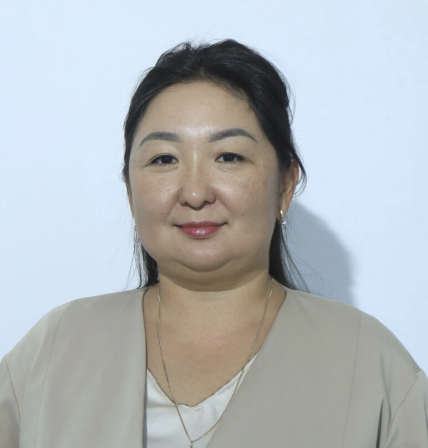
Image Source: https://www.nmu.edu.kz/pfofessor_okitychi_kuramy/
Aksholakova Asem Zhaksybekovna
Head of the Department of Foreign Philology and Translation, Egyptian University of Islamic Culture Nur-Mubarak
Ph.D. in Linguistics, Masters in Philology from Al-Farabi Kazakh National University
Asem’s Story:
Asem is a Doctor of Linguistics currently working at Egyptian University of Islamic Culture Nur-Mubarak. She is the head of the Department of Foreign Philology and Translation Studies and currently teaches English. She has a husband and a son, and at home she splits the household labor with her husband, who also works.
Gender and Marriage in Kazakhstan
-
It's very normal in Kazakhstan; there are a lot of women holding various leadership positions. We don't really have any restrictions. People here view women and men equally. That is, a woman has the right to study, to work, and to get married not just when she feels like it, but when the time comes. In this regard, we differ slightly, from the customs in, for example, Uzbekistan, Turkmenistan, and Tajikistan in particular. In our country, so to speak, men and women are on equal footing.
I believe that men and women are on the same level in Kazakhstan. If I need to, say, meet up with girlfriends or have some meetings, of course I let my husband know first and foremost. It's not that I ask for permission, but then again, I don't just inform him and say, “On Friday at 05:00, I'm going out.” No, well, it's something in between. Like, whether it's okay and asking to go. For example, I would say “The girls are getting together on Friday, it's someone's birthday. Can I go? Could you watch the kid?” And he might definitely ask, “Until what time?” For women, staying out past 12am, that is seen as a bit disrespectful to the husband. At that point, the husband would already have started calling, finding out where you are, why you're out so late.
I also think a married woman who has a family and a child or children, hey should know that there are boundaries you cannot cross. You still have to respect those limits because your status is different now. When you are unmarried, it's completely different. And even knowing that nothing bad will happen at home, if I am out with the girls, I still come back home at the specified time.
-
In our culture, we are taught that a woman, a girl, is first and foremost a mother; first and foremost a wife. And she must somehow combine both studies and marriage; so that they would also think about the fact that they need to get married.
If you are already closer to 30 years old, not only parents but also relatives start saying, “It's time for you, you need to get married already.” Of course, they are happy and proud if you are not married, but you have a very good, promising job. But still, first and foremost for us Kazakhs, it is of course family life; that women specifically fulfill themselves as a mother, as a wife, men as a father and husband. The age when it is already high time to get married has maybe shifted just a little bit. Before it was 20-25, now it is probably 25-30.
-
Parents try to buy housing for not only their sons, but for their daughters as well. Why? Because now, there's a lot of abuse going on, when husbands beat their wives or don't let them have what they want. Many young women worry and are afraid to tell their parents. And for Kazakhs, getting a divorce, especially if you have a child, or several, is kind of a bit shameful. Especially if a woman tries to come back home, because if she doesn't have a place of her own, where else can she go back to? Some girls still stay silent and endure this bullying from their husbands.
Now, fathers see all of this and, starting from childhood, start looking for housing and apartments so that their daughters can be financially independent. They explain to their daughters that they shouldn't be afraid, that they need to speak up, that their parents will always support them, that there's nothing wrong with it, and so on.
Working Life
-
It is not difficult for me. Why? Because I have one child. Perhaps, if I had more than one it might have been… Well, I won't say difficult. You see, for Kazakhs, looking after children... We don't say it's difficult or that we get tired.
Secondly, my husband personally helps me with everything. He makes dinner when I am busy with work. Even on weekends, when I do some cleaning and tidying, he also goes around helping me because he sees that I am also busy.
I don't just sit there, I also have very little time. In the evening, after you come back home, after cooking, after washing the dishes, you already have to prepare the child for the next day. Of course, my husband sees all of this, and he tries to help me with everything. So I cannot say that it is difficult for me to maintain some kind of balance. I think women are versatile.
-
I had essentially no obstacles, For this position, to be honest, they were trying to convince me to take it even before I did.
I am like that myself, since I got married very late, at 36 years old. There were a lot of conversations from my parents, from relatives, from my brothers. When I got married and experienced the feeling of motherhood, I wanted to devote more of my time specifically to my child and my family. That is, to focus on my child, take him to the pool, take him to all kinds of activity clubs. When the leadership position was first offered to me, to be honest, I refused. I refused for two years, because I kind of begrudged; it was time I could be spending with my child. Instead, I would have had to spend it at work.
Up until 36 years old, I thought I was a careerist; that career was the priority for me. But then, later on, I felt that there is so little time, and you want to see your child growing up, and I wanted to be with my child all the time. But that’s just me.
Eventually I agreed, because they simply left me no choice. They said, “Look, you’ll take it if you care about your colleagues, if you want something for them, if you have some ideas that you want to bring to life, if you see that something is off, or some plans to implement, then this is precisely the right time.” And honestly, I kept hesitating, but I told my husband and he told me, "Go for it, go ahead."
Religion
-
Of course, religion plays a large role in my life. If there were no law, how would people live, right? If there were no traffic rules of some kind, what kind of chaos would there be on the road? Religion acts in that same way. It kind of guides a person. I wouldn't say it's a law, but in certain decisions, like when you don't know what to decide, religion somehow puts everything in order for you.
I work at a university—the Egyptian University of Islamic Culture. There are majors specifically in Islamic studies, religious studies, theology. Somehow with age, you feel that religion is needed. I think when you believe in God, it is very easy for a person to live.
-
It’s not really the case that there is a difference between men and women in religion.
For instance, at our university, even students address each other formally. There is a very deep meaning in this. Because when you address a person formally, it means that in the future you cannot allow yourself to do something like quarrel, yell, scold, or raise your voice. Already this formal address shows that there must be some sort of respect, even between students studying in the same group. And we also have families that strictly adhere to religion, where a wife addresses her husband formally. I mostly use the informal 'you', of course, but there are families that just use the formal 'you'.
I don’t think that a return to Islam affects women more than men, because faith is inside every person. Though, of course, there are some very religious families where husbands might forbid their wives from working, or even forbid their sons' wives from working. But I believe that such overly religious families misunderstand Islam.
-
I lived during the Soviet Union. I was still young, but I remember. During Soviet times, even though it was forbidden, my parents say that my grandfather and grandmother fasted and prayed. Yet at the same time, they never talked about it out loud or anything like that. Not because they were afraid, they just didn't talk about it; it was just inside them.
Now, I see that young people are more and more turning to religion. Not even those who once lived or were around during the Soviet Union, but the current generation—they have become so religious.
Even at the university, we have a trend now of people enrolling in first year Islamic studies. Not students, but people who graduated from higher education institutions a few years ago. These can be from different fields, they can be biologists, chemists, there are even those who already have some experience in a certain field. They consciously enroll in the first year specifically to understand religion better and to be specifically educated in religion. When you ask them, "So why are you enrolling? Do you specifically want to work in this field?" They say, "No, we just want to understand Islam correctly, because the interpretations vary."
Everything in the Quran is written in such a way... not directly, but implied. That is, a person who knows the religion and understands it can somehow interpret the Quran correctly. And these new students think that our university is the only one in Kazakhstan where they can come and study, get the right guidance, and understand religion correctly. They say, "We want to understand it correctly ourselves first, and then teach our children." It is very interesting.
Family Anecdotes
-
Our generation was a little bit different. In our generation, for example, when guests came over, children were never seated with them. We didn't sit at the table, and everything good, everything delicious was always for the guests. And when guests came, honestly, our parents didn't ask, "Can someone sleep in your room?" They would just let the guests sleep there. And, when guests came over, we would look after their kids. When everything was over, we had to help out.
Now, it's changing everywhere. For instance, we even ask a young child, "Can we use your room? Can they just hang out in your room?" We listen to their opinion. But at the same time, our parents' way of raising us was definitely better in any case, I think, because we were closer. If we saw Mom washing dishes, we couldn't just sit there and watch her do it. But kids nowadays are changing; they’re already a little bit selfish.
-
Since childhood as Kazakhs, even without taking religion into account, we saw that our dad was always the head of the house. Regardless of whether the husband has a lower work position or earns less than his wife.
In Kazakh tradition, the father's role is specifically very high. We always had to do what Dad told us to do; that was the rule. Of course, I wouldn't say he forced us. He just knew how to be strict. And at the same time he was very gentle too. I never saw my mom complaining to anyone, saying anything bad about Dad, for instance.
Or, let's say, in my case. If we have any problems, either my husband or me, we never tell our relatives, unless you really, truly don't know who else to vent to. Of course, for that you can call or talk to friends, to a girlfriend, but even then, it's not everything. t goes here
-
I chose for my child to go to a Kazakh school. I'd like him to have a Kazakh upbringing, a Kazakh environment. My husband, for instance, is Russian-speaking, he finished school in Russian, while I finished in Kazakh. Even in this, differences sometimes show up in how we view things. You can feel some kind of difference when we decide something, and it shows. For instance, when he talks with his brothers and sisters. Even when we're sitting together, they can talk about various topics, and they can discuss topics not about themselves. They might say, "There was this love [sex] scene." Whereas with my brothers, for instance, even though we're already over 40 years old, we don't talk about such things. For us it's a bit shameful. You can feel that my husband’s family discusses all this quite openly.
Maybe it’s a good thing when, for example, you're going to do something, you don't think about yourself first. You think, “What will other people say? What will the relatives say? What will Mom or Dad say?” They say when a person dies, people might come, cry, and half an hour later they'll forget you. So what? You should live the way you want, without thinking about who will think what, what this relative will think, what that relative will think.
In any case, this upbringing of ours, where you think you might do something wrong and someone might judge you, it keeps people in check from doing something bad. I think there's nothing wrong with that either. It’s not good if a person only thinks about themselves, like “I'll just do whatever I want.” Since you live in a society, since you have parents and people who care about you, you probably need to consider them too and think about what they might think.
Definitions and Cultural Context
-
Domestic violence persists to this day as a serious problem for Kazakh women. Reports are often dismissed as ‘personal’ or ‘administrative’ violations rather than criminal acts, which makes it even harder for women to come forward and escape dangerous home situations. Women are continuing to fight for reforms to laws which would protect them and work towards justice in cases of domestic violence.
-
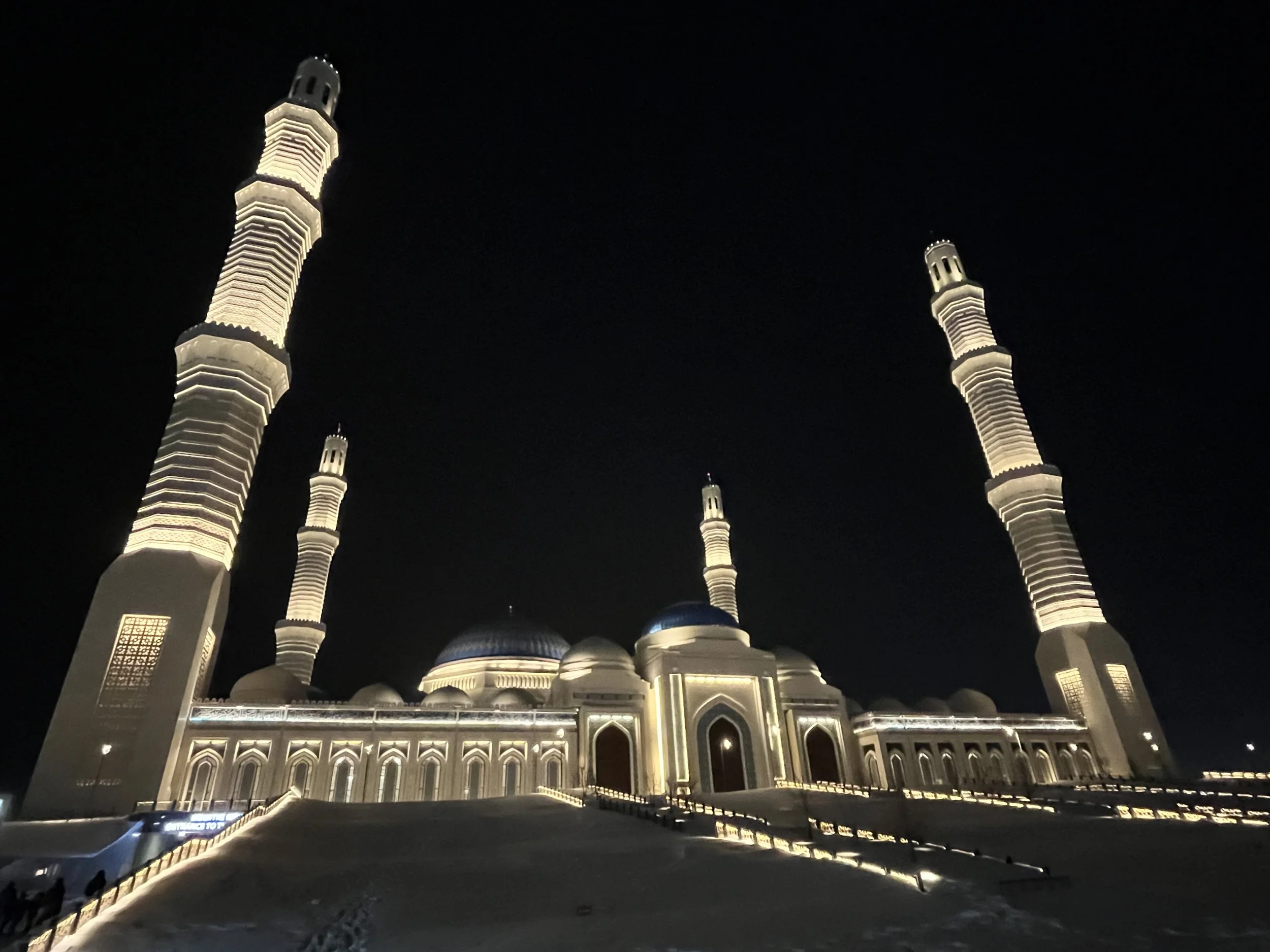
While religion was suppressed during Soviet control of Kazakhstan, the country has seen a return of religion, particularly Islam, among young people. Since the fall of the Soviet Union, Almaty has seen an increase of mosques from 68 to over 2,200. Religion and state are still strictly separate, and Kazakhs often describe their religion with more of an emphasis on Kazakh tradition and culture.
Source: https://qantara.de/en/article/islamic-revival-kazakhstan-pragmatic-islam
-
Hospitality is central to Kazakh culture. It stems from a long history of nomadism, where families always had to be prepared to welcome in guests who were traveling through the area. A guest of a Kazakh home can expect to be welcomed with open arms, abundantly fed, and repeatedly served tea (or shay).
*Check below for a picture of my experience with Kazakh hospitality!
Source: https://sites.bu.edu/gastronomyblog/2017/07/28/the-importance-of-hospitality-in-kazakhstan/
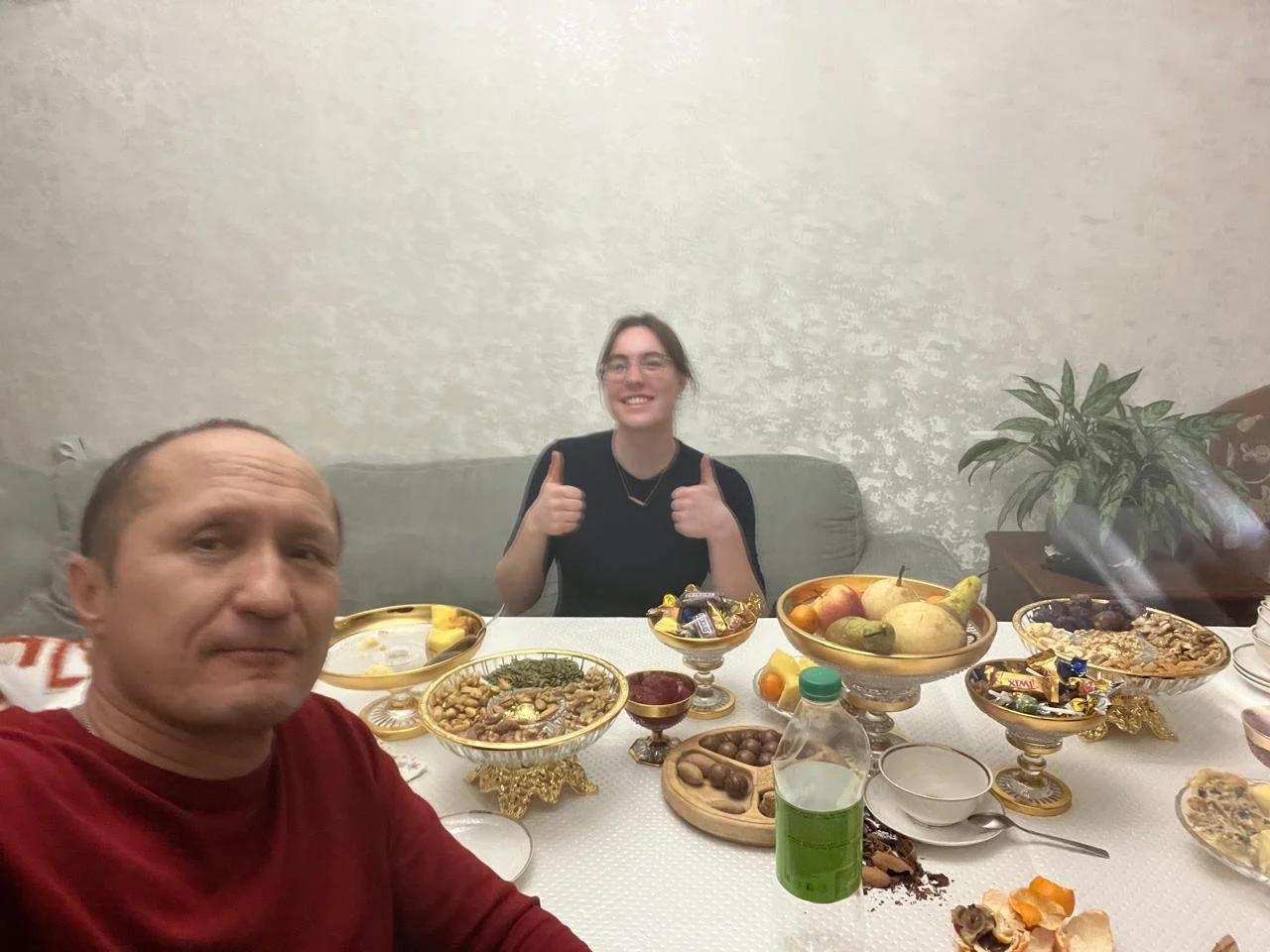
My host uncle and me enjoying fruits and nuts after a feast of beshbarmak… standard Kazakh hospitality!